The tech giant on Thursday reported that profit from the three months
ended in December grew more than 200% year-over-year to $14 billion,
exceeding Wall Street analysts’ expectations. Sales from the quarter
grew 25% from the year-ago period to more than $40 billion.
The company also announced its first-ever cash dividend of $0.50 per
share to be paid out on March 26 to shareholders of record as of
February 22, as well as a $50 billion share buyback. Buybacks and
dividends help to boost stock prices by rewarding investors with cash
just for holding the stock — but they’re widely criticized for
artificially inflating the stock price without spending on employees or
improvements to the underlying business.
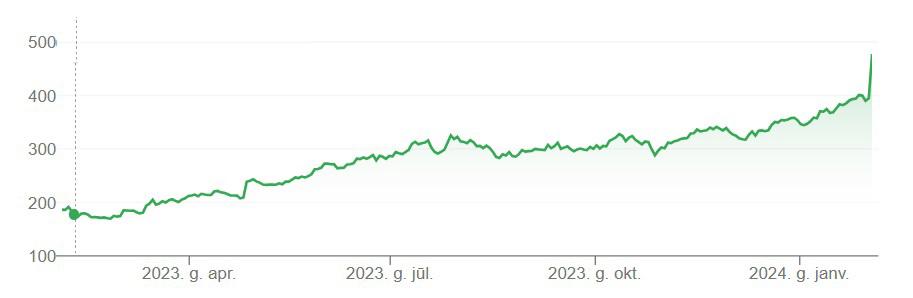
...From $186.53 to $474.99 in one year
...
“We intend to pay a cash dividend on a quarterly basis going forward,” the company said in a release
The news sent Meta shares popping more than 14% in after-hours trading Thursday.
Thursday’s report marked the fourth quarter of Meta’s self-described “year of efficiency,” which Zuckerberg announced in February
of last year. The turnaround strategy involved layoffs and other cuts
to spending in what ended up being a stunningly successful effort to
reverse the prior year’s revenue declines and share price weakness.
For the full year in 2023, Meta’s profits grew 69%
year-over-year to $39 billion, the company reported Thursday. As of
Thursday’s closing bell, Meta’s stock had gained 109% since this time
last year.
Meta said Thursday that as of the end of 2023, it had
“completed the data center initiatives and the employee layoffs, and
substantially completed the facilities consolidation initiatives.”
“Our communities are growing and our businesses are back on track,” CEO
Mark Zuckerberg said on a call with analysts Thursday evening. “A big
thank you to all of our employees, partners, shareholders and everyone
in our community for sticking with us and making 2023 such a success.”
Thursday’s report also comes one day
appeared on Capitol Hill alongside industry peers to testify about the
impact of the company’s platforms on young users. During the hearing,
Zuckerberg issued a rare apology to parents of children who had been
harmed by Facebook and Instagram who were in the room.
“No one should go through the things that your families have
suffered, and this is why we invest so much and are going to continue
doing industry-leading efforts,” Zuckerberg told parents.
The company said Thursday that its Facebook daily active
users grew 6% year-over-year to more than 2.1 billion. But, in a move
Meta had signaled previously, Meta CFO Susan Li said the company will no
longer report Facebook user numbers — a sign of the company’s focus on
its larger family of apps and, potentially, the smaller growth potential
for Facebook given its already massive scale.
Going forward, Meta will report only daily active people on
its family of apps, which reached an average of 3.19 billion in
December, the company said.
Zuckerberg also noted Thursday that Threads — the rival to
X, formerly Twitter, that Meta launched late last year — has reached 130
million monthly active users, indicating strong growth, although the
platform remains smaller than competitors.
Another highlight from Thursday’s report was a 2%
year-over-year jump in Meta’s average price per ad in the December
quarter, a key indicator of the company’s core advertising business. The
December quarter marked the first time last year that average price per
ad grew rather than declined.
In the first quarter of 2024, Meta expects revenue of
between $34.5 billion and $37 billion, a 20% year-over-year jump on the
low end.
...company’s focus on its larger family of apps
...
Meta details AI investment plans
Zuckerberg said late last year that artificial intelligence
would be Meta’s biggest investment area in 2024, and the company on
Thursday provided some clues about what that spending would look like.
Meta expects full-year capital expenditures to be between
$30 billion and $37 billion — a $2 billion increase of the high end of
the range it previously reported — which the company said would be
driven by investments in AI and non-AI servers and data centers,
including new data center construction.(Capital expenditures, broadly, are what a company spends on physical assets, such as factories or equipment.)
“Our updated outlook reflects our evolving understanding of
our artificial intelligence (AI) capacity demands as we anticipate what
we may need for the next generations of foundational research and
product development,” the company said in Thursday’s release, adding
that it expects “our ambitious long-term AI research and product
development efforts will require growing infrastructure investments
beyond this year.”
Meta last year rolled out new AI tools for brands in a move
aimed at boosting its advertising business, which had taken a hit from
Apple App Store privacy changes that went into effect in 2021. Li said
that “initial adoption of these features has been strong” and that the
AI ads investments would “remain a big area of focus for us in 2024.”
Zuckerberg also said earlier this month that Meta plans to build its own artificial general intelligence, known as AGI, in a sign of the company’s desire to continue to be a serious player in the AI arms race.
The company has also continued to invest heavily in its
Reality Labs unit, which houses its investments in building the
metaverse, Meta’s vision for an immersive form of the internet that
relies on virtual and augmented reality.
In 2023, Meta posted a more than $16 billion loss for
Reality Labs. Li said the company expects Reality Labs operating losses
to increase “meaningfully” this year.
...Meta expects full-year capital expenditures to be between $30 billion and $37 billion — a $2 billion increase of the high end of the range it...





 North America





 Add comment
 Edit
 Remove
 Like!
 Dislike


