


 North America
Taix was more than candles, soup, and wine,
It held a city still inside its line.
Now Sunset loses one room to the night,
And Los Angeles grows dimmer by that light.





 Ernst Birkholz
Follow
 29.Mar.2026, Taix French Restaurant, 1911 W Sunset Blvd, Los Angeles, CA 90026
Taix was more than candles, soup, and wine,
It held a city still inside its line.
Now Sunset loses one room to the night,
And Los Angeles grows dimmer by that light.
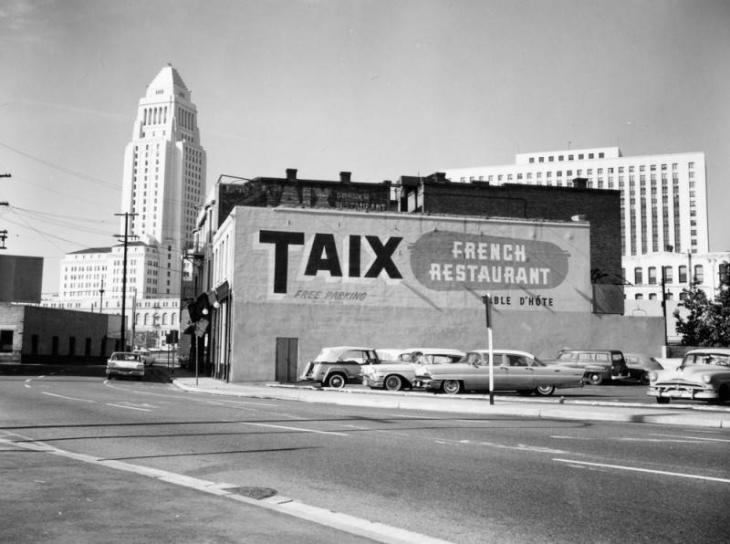
A restaurant can be beloved for its food, admired for its room, and cherished for its history. Taix was unusual because it carried all three forms of value at once. As it served its last meals at the old Echo Park address, the frenzy around the place was not nostalgia pretending to be appetite. It was appetite sharpened by the knowledge that Los Angeles was losing one of the rare dining rooms that still made the city feel ceremonious, communal and unmistakably itself. Taix first opened in 1927 and had occupied its Sunset Boulevard home since 1962; its final service at that version of the restaurant arrived this weekend as redevelopment closed in around it.
The easiest mistake to make about Taix is to frame it as a pure relic. Yes, its aura was old-school. The banquettes, the deep rooms, the scale of the place, the sense that a proper evening out should involve time rather than turnover: all of that belonged to another dining era. But relics do not draw lines down the block. Relics do not make people steal menus for keepsakes. Taix mattered because it still functioned. It still gave diners a kind of hospitality Los Angeles keeps claiming to value even as it lets the physical spaces that embody it disappear.
The menu explains part of the attachment. Taix’s own current materials still describe it as Los Angeles’s oldest French restaurant, and the food reads like a defense of French-country comfort against trend fatigue. There is baked French onion soup, escargots de Bourgogne, mussels done maison or marinière, pâté, beet salade, frog legs Provençal, trout almondine, steak frites au poivre, roast chicken with pomme frites, duck à l’orange on Saturdays, and a traditional add-on of soup and salad that makes the meal feel larger than the entrée alone. This is not food designed to chase novelty. It is food designed to reassure you that pleasure can survive repetition.
And that is why Taix deserved a better ending. Its appeal was not built on being the city’s sharpest kitchen or its newest reservation flex. It was built on constancy. The menu was confident enough to keep faith with escargots and French onion soup. The room was confident enough to remain grand. The address was confident enough to believe people would still come for dinner in a sprawling old building with banquet halls and a parking lot in a city that increasingly prices out any business not optimized for maximum real-estate efficiency. The Guardian’s farewell report cuts to the heart of the problem: Taix became too expensive, too large and too old-fashioned for the economics surrounding it, even as those very traits made it culturally irreplaceable.
A fair review of Taix, then, has to credit both the plate and the feeling. On the plate, the restaurant offered exactly what many legacy restaurants fail to protect: recognizable classics that still sound worth ordering. The escargots with parsley and garlic butter, the roast chicken au jus with fries, the mussels in white wine or cream, the peppery steak frites, the slow comfort of Sunday and Saturday specials — these are not museum pieces. They are dishes with enduring logic. In a dining culture increasingly split between algorithmic hype and stripped-down casual convenience, Taix made a strong case for the middle ground of occasion without intimidation.
But the feeling may be the larger loss. Discover Los Angeles described the place as authentic, well-dressed and affordable by French standards. Time Out called attention years ago to its extExterior shot ensive wine list, nightly specials and charming setting. Those descriptions read even more poignantly now because they capture what development language so rarely can: the social use of atmosphere. Taix was not just somewhere to eat. It was somewhere to arrive, to linger, to be seen by old friends, to turn dinner into memory before the entrée was even finished.
The restaurant is expected to return in a smaller form in the new complex. Perhaps it will. Cities often tell themselves that continuity survives downsizing. Sometimes it does. But scale is part of meaning. Rooms teach behavior. A large, ornate, slightly crumbling French restaurant on Sunset Boulevard teaches a different kind of evening than a reduced restaurant inserted into a redevelopment. Taix may come back by name. Whether the old spell can come back with it is another matter.
For now, the fairest verdict is this: Taix was never important only because it was old. It was important because it remained useful, beautiful and emotionally legible right up to the end. The city did not line up for a ruin. It lined up for a real dinner in a real room with a real sense of occasion. That is what made the last service feel less like a closure than an indictment. Taix deserved a better ending because it was still doing the job.

© 2026 - ossLand, v.2.17

 Add comment
 Edit
 Remove
 Like!
 Dislike


