





 North America
 23.Mar.2026, 10:00, First St NE, Washington, DC 20543, Amerikas Savienotās Valstis
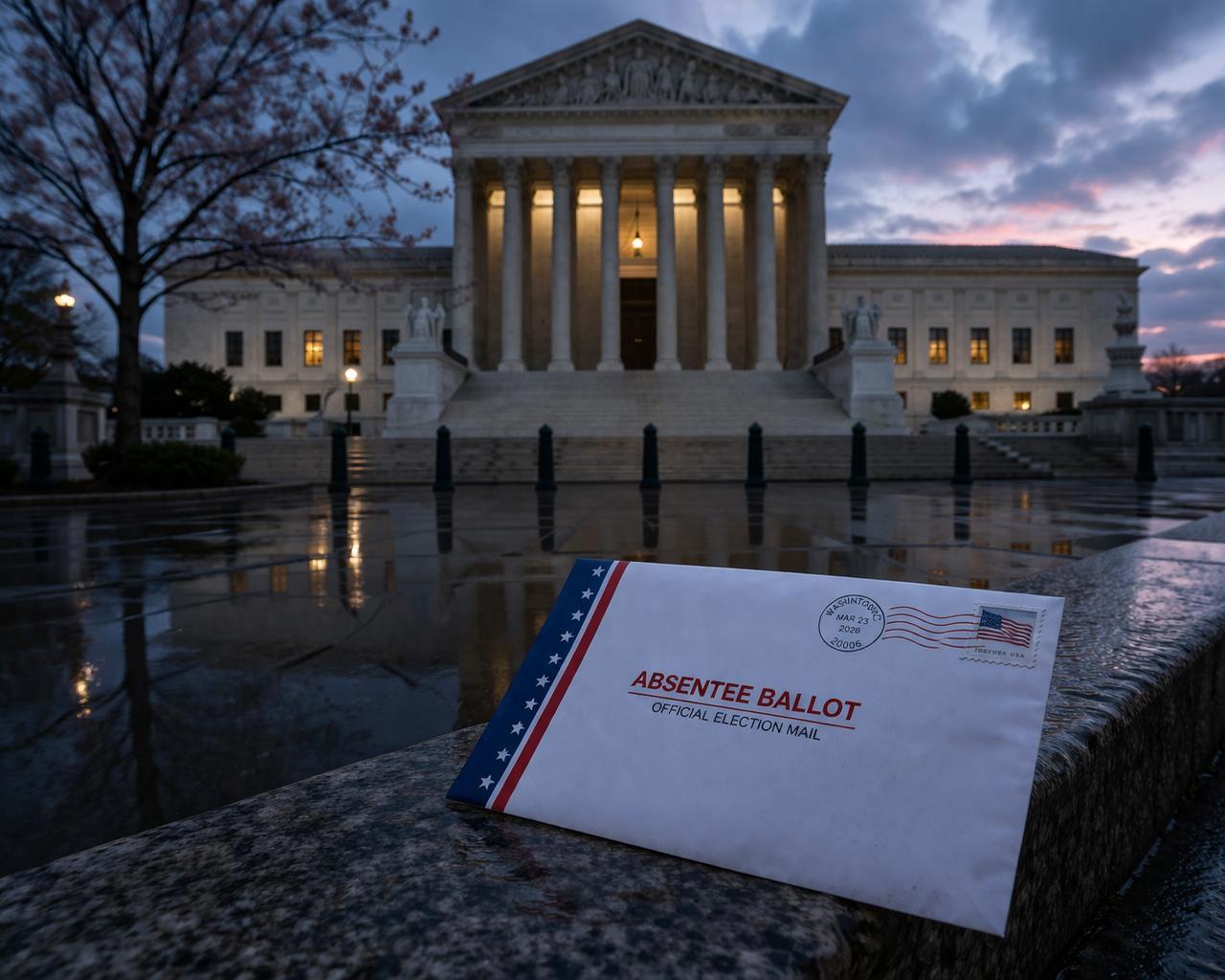
There are political fights that feel noisy and temporary, and then there are fights that change the machinery itself. The Supreme Court argument in Watson v. Republican National Committee belongs to the second category. On its face, the case is about a Mississippi rule that allows ballots mailed by Election Day to be counted if they arrive within five business days. In practice, it asks a larger and more volatile question: when does an election truly end? The Court’s answer could reshape how federal ballots are counted in 14 states and the District of Columbia, while also affecting rules for military and overseas voters in additional states. Oral arguments were heard on March 23, and the justices’ skeptical tone toward late-arriving ballots has already sharpened the sense that election administrators may soon be forced into a hurried rewrite of well-established procedures.
The legal issue is deceptively compact. Federal law sets Election Day for federal offices, but Mississippi argues that a ballot is “cast” when the voter mails or submits it by the deadline, even if officials receive it later. Opponents, including the Republican National Committee, argue that the election is not complete until ballots are physically received, meaning states cannot keep counting after Election Day closes. Cornell’s Supreme Court bulletin summarizes the question bluntly: does federal law require mail ballots to be both cast and received by Election Day, or may states count ballots received later if they were postmarked on time? That phrasing explains why so many election lawyers are watching this case with the intensity usually reserved for November itself. The dispute is not only about ballots; it is about whether timing rules belong mainly to states or whether federal statutes impose a harder national stop sign than many states have assumed.
What gives the case its emotional force is not abstract doctrine but geography, logistics, and trust. In Alaska, election officials and advocates told the Associated Press that remote communities depend on planes for mail delivery and that grace periods are treated as practical necessity, not partisan indulgence. California officials have warned that eliminating grace periods could burden systems that already rely on late-arriving ballots, same-day registration, and long certification windows. Mississippi’s rule itself is not exotic in modern election administration; it reflects an era in which voting by mail has become both more common and more politically contested. For supporters of grace periods, the issue is whether voters should lose a federal vote because the postal system, distance, or weather outran them. For opponents, the issue is whether confidence in election finality erodes when counting continues after the nation believes voting has ended. Both arguments are politically potent because both appeal to fairness, just in different directions.
That is why this case lands with such force in 2026. The midterms are not here yet, but the atmosphere around them already is. A ruling by late June, as AP reports, would leave only a few months for states, counties, and voters to absorb new rules, rewrite instructions, retrain workers, redesign public messaging, and manage inevitable confusion. Even people who dislike post-Election Day counting should recognize the administrative shock of changing procedures this close to a major national vote. Election law rarely changes in a neat laboratory. It changes in real offices, with real envelopes, real deadlines, and real voters who often learn the rules only at the point of stress. A decision that narrows ballot-receipt windows may be legally coherent and operationally chaotic at the same time.
The politics around the case are equally revealing. AP notes that late-arriving ballots have been a repeated target of Donald Trump, while the Court’s conservative majority signaled doubts during arguments. But what matters editorially is less the familiar partisan framing than the underlying lesson: American democracy is increasingly being fought over not only through persuasion, turnout, and messaging, but through definitions. What counts as “cast”? What counts as “received”? What counts as the end of Election Day? In an older political era, those questions might have sounded clerical. In this one, they can shape turnout, timelines, litigation strategy, and public confidence in the result.
For readers in the United States, the practical takeaway is plain. If the Court rules against Mississippi, expect a wave of warnings from local officials telling voters to mail ballots earlier than they think necessary. Expect campaigns to push harder for in-person early voting. Expect more lawsuits over voter education, ballot access, and overseas voting timelines. And expect a familiar civic paradox: the closer the legal system moves toward uniformity, the more uneven the real-life burden may feel across different communities. Rural voters, military families, overseas Americans, and people with less reliable access to postal service could feel that burden first.
In the end, this is not a story about envelopes drifting in after the deadline. It is a story about the national appetite for certainty. Courts like clean lines. Elections rarely offer them. The American system has long balanced finality against access, speed against inclusion, and administrative order against geographic reality. However the justices rule, they will not simply interpret a statute. They will choose which democratic inconvenience the country must live with next: the unease of waiting a little longer, or the anger of knowing some timely voters may arrive too late.

 Add comment
 Edit
 Remove
 Like!
 Dislike


